What if the consulting firm you bought last year could be replaced by an AI agent next year? What if the software business mediating workflows becomes obsolete when AI eliminates the workflow entirely? For some buyout managers, these aren't hypothetical questions. They are essential due diligence items.
While most private equity firms discuss AI as an opportunity, Roberto Quagliuolo, Head of Private Equity Italy, Tikehau Capital, revealed that they screen every service business, consulting firm, and software company for disruption risk before investing.
"When we look at service businesses, consulting businesses, software businesses, we always do a specific dive on understanding how this business can be disrupted," Quagliuolo told delegates recently at IPEM Global.
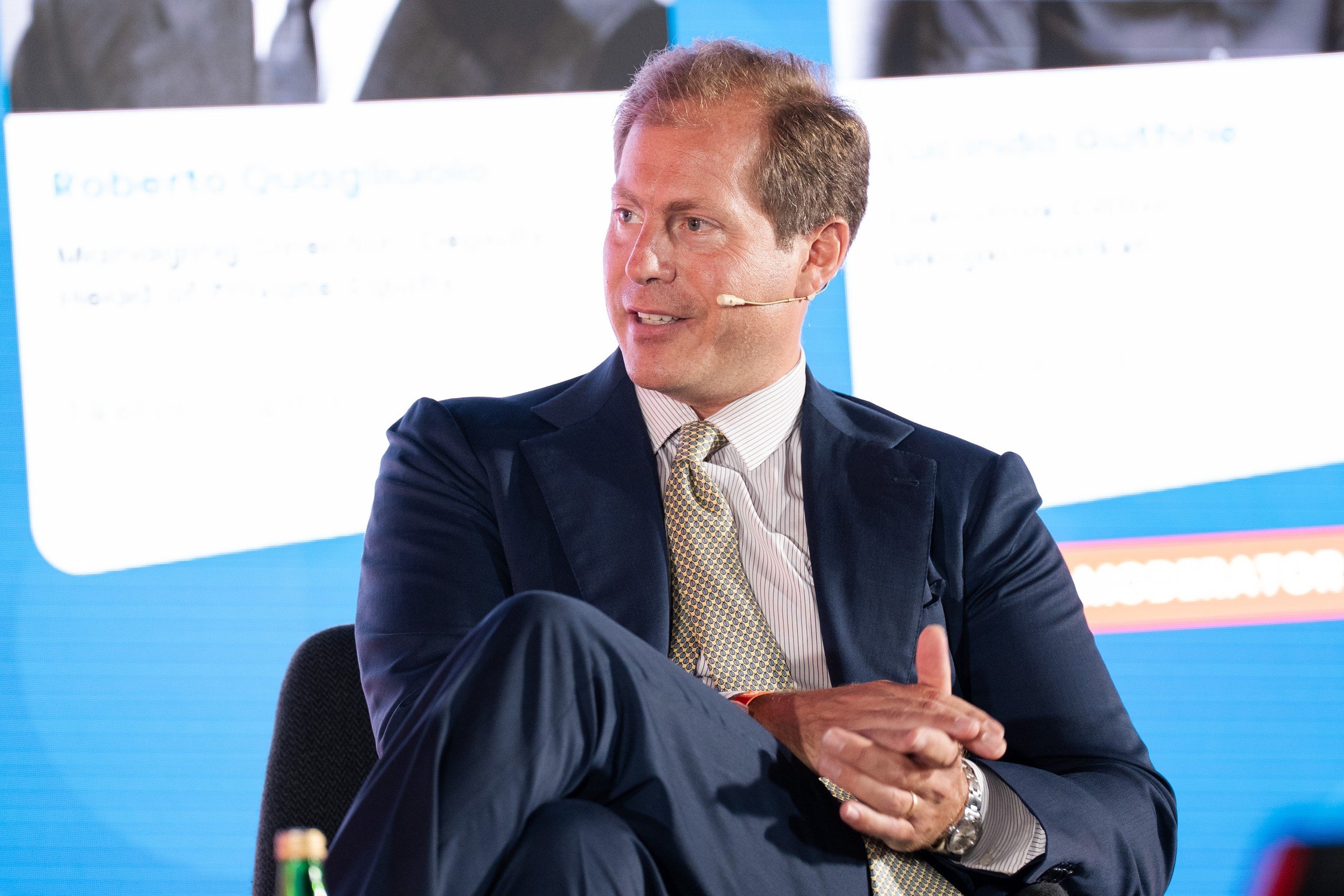
Photo: Quagliuolo talks to the risks and opportunities of AI.
The stakes are clear. In an environment where AI can eliminate entire business models overnight, deal origination has evolved from evaluating growth potential to assessing survival probability. LPs increasingly demand to understand how value is created and sustained, not just what returns look like.
Private equity firms sitting on portfolios acquired during the 2020-2022 vintage years, when valuations peaked and many paid premium multiples for software and services businesses, face a dual challenge: multiples haven't recovered to exit at attractive returns, and now AI threatens the underlying business models before fundamentals can grow into those valuations.
Protecting existing portfolio value has therefore become as critical as screening new investments.
What does Tikehau protect portfolio value from the AI threat?
Tikehau has sought to meet this challenge head on by integrating AI across three critical dimensions of the investment lifecycle:
-
Internal operations: Tikehau has developed proprietary AI tools for deal origination and document processing, building these on closed infrastructure to maintain confidentiality of sensitive materials.
-
Pre-Investment screening: During diligence, the firm conducts specific AI disruption analysis, particularly for businesses with high automation potential, to guard against buying companies vulnerable to new AI applications.
-
Portfolio defence: For owned companies, Tikehau actively monitors for disruption threats and pivots business models when necessary.

Photo: A panel featuring Rob Seminara of Apollo, Brian Bernasek of The Carlyle Group and Roberto Quagliuolo of Tikehau.
From hunted to hunter
This 3D framework was used effectively when Tikehau faced disruption at a portfolio company providing digital advertising automation software.
As Quagliuolo said: "We had to quickly shift the business model using an agentic AI approach."
The solution involved creating dual data lakes at both the company and the end client level, deploying agentic AI to handle repetitive tasks that previously required software-mediated human exchange. Instead of being disrupted, the company gained significant market share, even penetrating the US market where competition from Silicon Valley tech companies is fiercest.
The rapid advancement of agentic AI has accelerated the timeline for disruption.
Service businesses that seemed safe two years ago now face existential questions. Consulting models built on repetitive analysis are vulnerable. Software companies that mediate workflows risk becoming obsolete if AI can eliminate the workflow entirely.
AI across the investment lifecycle
For private equity firms still treating AI as a single initiative rather than an integrated threat across the investment lifecycle, the clock is ticking. Buyout managers can no longer afford to risk merely determining whether a business is good enough when building their deal pipelines. The question is whether the business in question can survive the next wave of automation.
Three questions now determine portfolio outcomes:
-
Which deals should we avoid because disruption is inevitable?
-
Which portfolio companies are vulnerable and need immediate pivots?
-
Can we move fast enough to transform threatened assets before competitors do?
Firms that are unable to answer these questions aren't just behind on AI adoption. They're holding portfolios with hidden obsolescence risk, and evaluating companies using frameworks built for a pre-AI world.

.png)
.png)