In this exclusive guest article, Justina Deveikyte shares the latest data on trends in private market evergreen funds based on Novantigo's proprietary data.
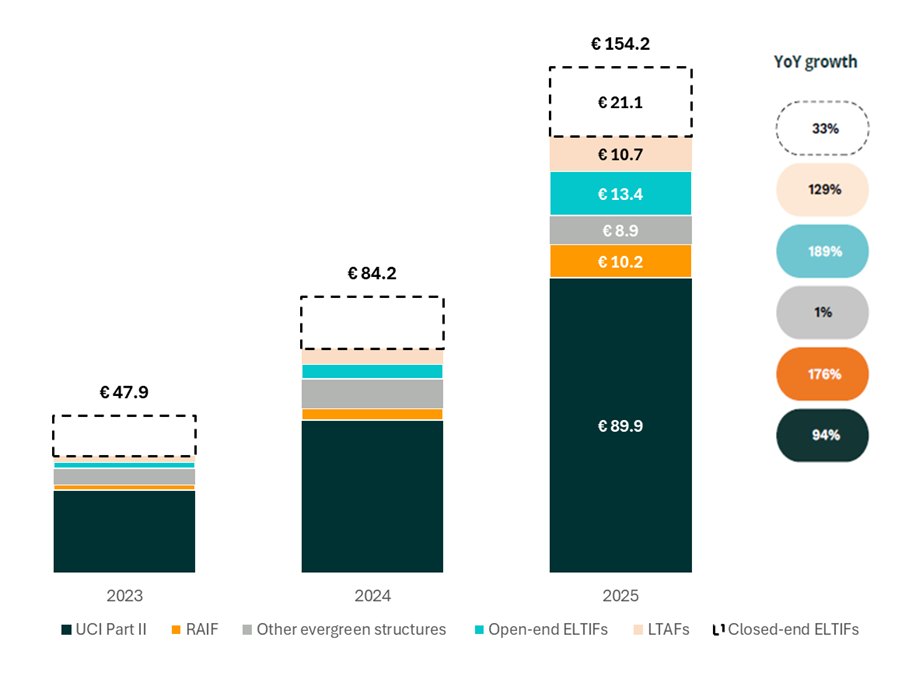
The European evergreen and ELTIF market expanded rapidly in 2025, with assets under management rising from €84.2 billion in 2024 to €154.2 billion by year-end – an increase of 83% year on year, according to Novantigo’s Evergreen Funds Navigator, currently covering over 430 funds across European markets.
Growth has been uneven across regulatory structures, with UCI Part II funds consolidating their position as the dominant evergreen vehicle. AuM in UCI Part II structures reached €89.9 billion in 2025, nearly doubling from €46.5 billion in 2024.
Several other structures, however, recorded even faster relative expansion. Reserved Alternative Investment Funds (RAIFs) grew by 176% between 2024 and 2025, while open-ended ELTIFs expanded by 189% over the same period, albeit from a smaller base.
Within the ELTIF segment, the market is also shifting structurally toward evergreen structure. Closed-end ELTIFs continue to represent the majority of AuM, accounting for 61% of the market in 2025, although this share declined materially from 77% at the end of 2024. Open-ended ELTIFs now represent 39% of total ELTIF AuM and 36% of all ELTIF vehicles, highlighting growing investor and distributor appetite for more flexible private market structures.
Exhibit 1: Europe-domiciled evergreen funds and ELTIFs AUM, 2023-2025 (in billion)
Source: Novantigo Evergreen Funds Navigator
Fund launches continue to accelerate
Fund launches across Europe’s evergreen and ELTIF landscape continue to accelerate, underlining the rapid expansion of evergreen private market solutions for wealth channels. According to Novantigo’s Evergreen Funds Navigator, 2025 has been a record year for new product registration. In total, 165 new funds were launched during last year across different structures including ELTIFs, UCI Part IIs, RAIFs, LTAFs, ICAVs, and FCPs.
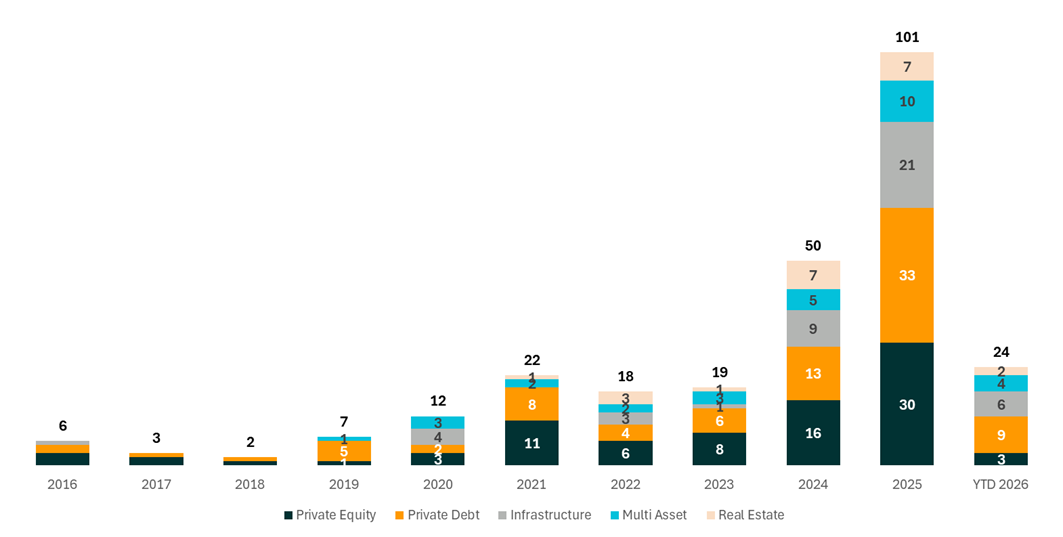
ELTIFs accounted for the majority of new fund launches, with 101 launches in 2025 alone, more than doubling from 50 in 2024 and marking a record year for the structure (see Exhibit 2). Momentum has continued into 2026, with 24 new ELTIFs launched as of May. Private debt remains the leading strategy within the ELTIF market, reflecting continued demand for yield-oriented private market exposure despite recent redemption and gating pressures in the US market. Infrastructure is the second most active category with 6 launches, while multi-asset strategies continue to gain traction with 4 new funds launched so far in 2026, signaling rising investor appetite for diversified private market solutions within evergreen fund structures.
For smaller private banks and wealth management firms, building and maintaining a full suite of five or six single-asset private market funds is often not feasible. Instead, they favour integrated solutions that provide exposure across asset classes within a single structure – preserving a growth-oriented profile while mitigating the volatility associated with single-asset strategies.
Market feedback reinforces this trend. Asset managers report increasing participation in RFPs where multi-private-assets solutions are explicitly preferred. Partnerships involving firms such as Partners Group with Deutsche Bank and Erste also suggest that demand for multi-asset structures is extending beyond smaller wealth managers to larger and more sophisticated distributors.
At the same time, interest in customized and white-label evergreen solutions continues to increase. Over the past 12 to 18 months, managers have engaged in a growing number of discussions around developing tailored evergreen fund structures for individual distributors. However, a clear “chicken-and-egg” dynamic persists: securing mandates often requires an established track record in the multi-asset space, yet building that track record depends on winning initial allocations. In this context, existing multi-private-asset capabilities – such as those already established by Partners Group – appear to have become an important differentiator in both white-label mandates and broader fund selection processes.
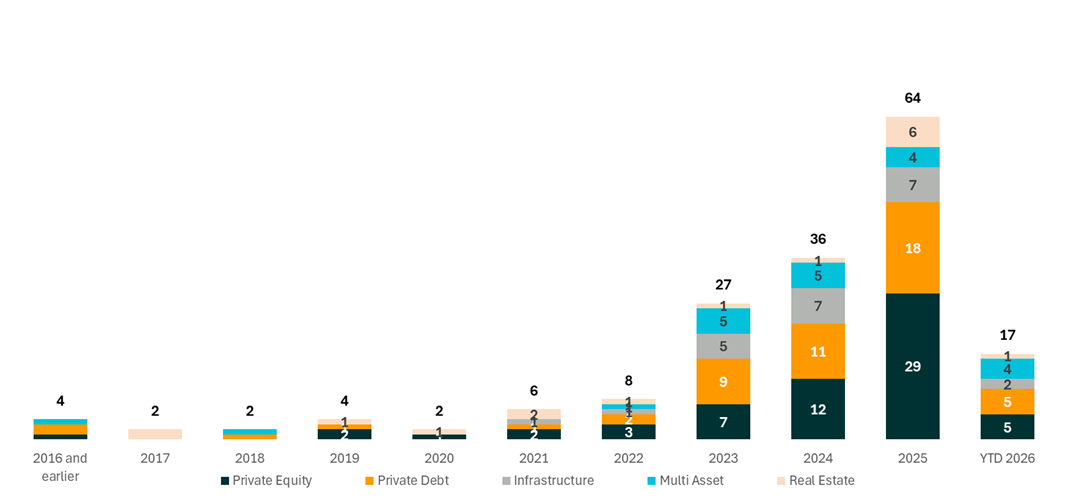
Outside the ELTIF framework, Novantigo tracks 172 non-ELTIF evergreen funds (see Exhibit 3). The segment also recorded strong growth, with launches rising from 36 in 2024 to 64 in 2025. In 2026, 17 new non-ELTIF evergreen funds have already been registered, including 5 private equity funds, 5 private debt funds, 4 multi-asset funds, 2 infrastructure funds, and 1 real estate fund. Most of these launches continue to adopt the UCI Part II structure, reinforcing its position as the preferred regulatory framework for evergreen private market products outside the ELTIF regime.
Exhibit 2: Number of Europe-domiciled ELTIF launches by asset class (as of May 2026)
Source: Novantigo Evergreen Funds Navigator
Exhibit 3: Number of Europe-domiciled non-ELTIF evergreen fund launches by asset class (as of May 2026)
Source: Novantigo Evergreen Funds Navigator
Evergreen private credit fundraising shows continued resilience in early 2026
Despite recent negative headlines surrounding evergreen funds and in the private credit space, most private banks and wealth managers we spoke with across Europe and Asia over the past several months report that redemption activity has remained broadly within normal ranges, with no material increase in outflows. While private credit fundraising appears to be showing early signs of moderation following several years of exceptionally strong growth, current AuM data for evergreen funds as of February and March 2026 does not indicate any broad-based slowdown in fundraising momentum.
On the contrary, several private credit evergreen funds continue to attract capital at a healthy pace. Preliminary data suggests that AuM across private credit non-ELTIF evergreen funds increased by approximately 11% during 1Q 2026, although reporting remains incomplete as some funds have yet to publish March 2026 figures. Among the strongest performers in terms of net asset value growth during the first months of this year were ARES European Strategic Income Fund, Goldman Sachs European Credit strategy, CVC–CRED European Private Credit, KKR Income Trust, and Pantheon Global Credit Secondaries Fund. Overall, the data suggests that investor appetite for income-oriented private market solutions remains resilient despite increased scrutiny of evergreen fund liquidity dynamics.
Are evergreen fund launches aligned with distributor appetite?
Despite heightened market scrutiny around liquidity management and redemption dynamics in certain evergreen structures, most private banks continue to view evergreen private market funds as a strategic long-term allocation rather than a cyclical opportunity. As a result, onboarding pipelines for 2026 remain robust across Europe.
Novantigo’s latest survey results indicate that 55% of firms expect to add one to two new evergreen funds to their platforms during 2026, while a further 38% plan to onboard between three and five additional strategies. Although a small number of institutions have adopted a more cautious “wait-and-see” approach amid current market volatility, the broader direction of travel remains positive, supported by continued client demand for evergreen funds and the growing maturity of evergreen fund structures.
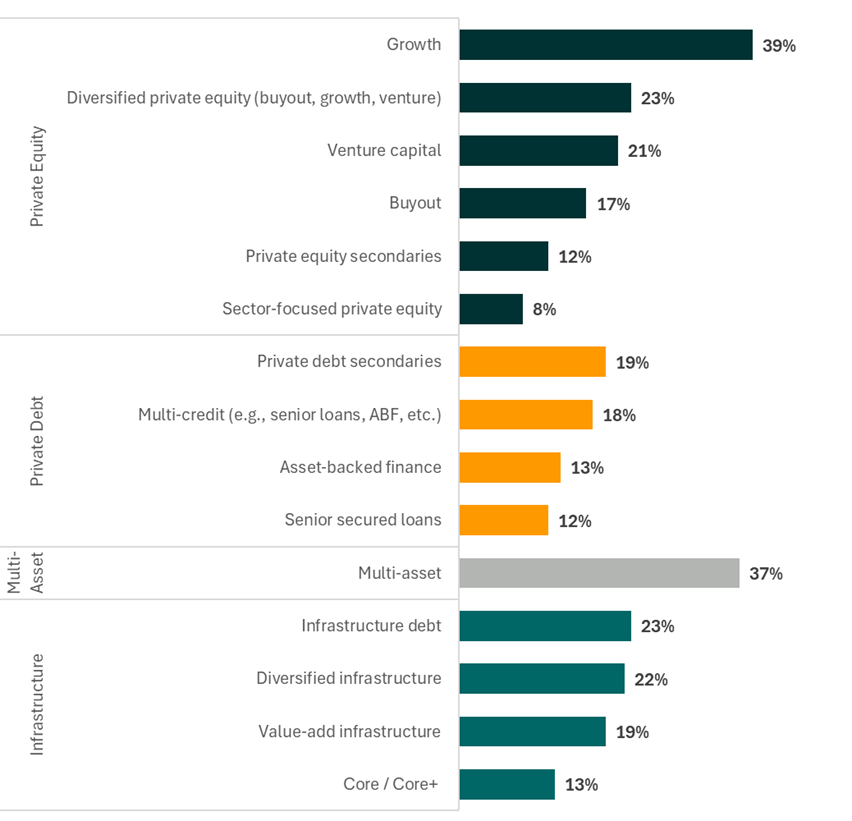
The current onboarding pipeline also reflects a clear evolution in investor preferences. Private equity evergreen funds are expected to remain the most sought-after category, with 39% of private banks and wealth managers indicating plans to onboard growth-focused strategies in 2026. Multi-asset private market solutions have emerged almost equally important, with 37% of institutions considering additions in this segment this year. This trend aligns closely with recent launch activity in the market, where multi-asset ELTIFs have been among the fastest-growing categories. Private banks increasingly view these diversified structures as an efficient “core private markets” allocation that can reduce single-asset-class concentration risk while simplifying portfolio construction for wealth clients.
Institution size continues to shape onboarding priorities and product architecture. Smaller private banks show the strongest preference for multi-asset evergreen funds, with 49% considering additions in this category, as these products provide efficient all-in-one exposure for clients with smaller overall portfolios. Larger institutions, by contrast, are increasingly focused on filling highly specific gaps within their product shelves. These firms show strong interest in private equity growth strategies (48%), multi-asset solutions (41%), and private debt secondaries (34%), while also seeking greater diversification across managers, sectors, and geographies.
Infrastructure strategies also continue to gain momentum within onboarding pipelines, particularly infrastructure debt and diversified infrastructure equity strategies, as investors seek a combination of income generation and defensive portfolio characteristics.
Conversations with private banks further highlight how the evergreen market is becoming more sophisticated and selective. At the same time, banks are increasingly prioritizing diversification across regions and strategies. While many existing evergreen offerings remain concentrated in US-focused managers, several institutions are actively seeking broader European and Asian exposure to complement existing product shelves.
Managers are beginning to respond to this demand through the launch of more regionally focused evergreen strategies. For example, Hamilton Lane launched its Asia Private Assets Fund last year, with assets under management reaching $135 million as of March 2026. EQT has also recently registered its EQT Nexus Asia fund, underscoring growing industry interest in Asia-focused evergreen solutions.
Exhibit 4: Evergreen strategy additions under consideration by asset class for 2026
Source: Novantigo Private Assets in Private Wealth Portfolios Europe - Evolving Selection Trends and Preferences
The data and insights in this article are drawn from Novantigo's proprietary research on private assets in wealth management across Europe and Asia-Pacific, and from the Evergreen Funds Navigator – our continuously updated DataHub tracking over 430 Europe-domiciled evergreen funds and ELTIFs on over 50 datapoints and fund features. To access the full dataset, request a demo, or learn more about our coverage, please contact the Novantigo team.


.png)